
Data Matrix vs QR Codes: Which Is Best for Industrial Part Marking?
Data Matrix and QR codes may look similar, but they are not interchangeable in every application. Choosing the wrong code can create scanning problems, waste limited marking space, or prevent a manufacturer from meeting customer and industry requirements.
For most industrial traceability and direct part marking applications, Data Matrix is the stronger starting point. Its compact footprint makes it well-suited for identifying individual components, carrying serial or lot data, and supporting automated production systems.
QR Code is generally a better fit when the person scanning the code is a customer, technician, or operator using a smartphone to access digital content.
The right choice ultimately depends on:
-
Who needs to scan the code
-
What information it must contain
-
How much marking space is available
-
Which marking and scanning technologies will be used
-
What the part will experience during its lifecycle
-
Whether an industry, customer, or regulatory standard specifies a particular code
This guide compares Data Matrix and QR codes and explains how to choose the right 2D code for an industrial application.
Data Matrix vs. QR Code at a Glance
Both Data Matrix and QR Code are two-dimensional barcodes. Unlike traditional linear barcodes, they arrange data across two dimensions, allowing more information to fit into a relatively small area.
However, each code has different strengths.
| Consideration | Data Matrix | QR Code |
|---|---|---|
| Primary strength | Industrial identification and traceability | Smartphone access and digital engagement |
| Common users | Manufacturers, suppliers, inspectors and quality teams | Consumers, technicians and equipment operators |
| Typical reader | Industrial imager, fixed reader or machine-vision system | Smartphone or compatible industrial imager |
| Marking footprint | Generally more compact | Generally requires more space |
| Common data | Part number, serial number, lot number and production data | URLs, instructions, registration pages and digital content |
| Error correction | Automatically determined by symbol size | Selectable correction levels |
| Direct part marking | Commonly used | Possible, but less common |
| Regulated healthcare ID | GS1 DataMatrix is the approved 2D carrier | Not approved for regulated trade-item identification |
| Industrial fit | Unit-level traceability and automated production | Web-connected or customer-facing applications |
This comparison is a useful starting point, but the code cannot be selected in isolation. Symbol size, data structure, material, marking process, surface condition, lighting, scanner, and verification requirements all affect whether a code will perform reliably.
What Is a Data Matrix Code?
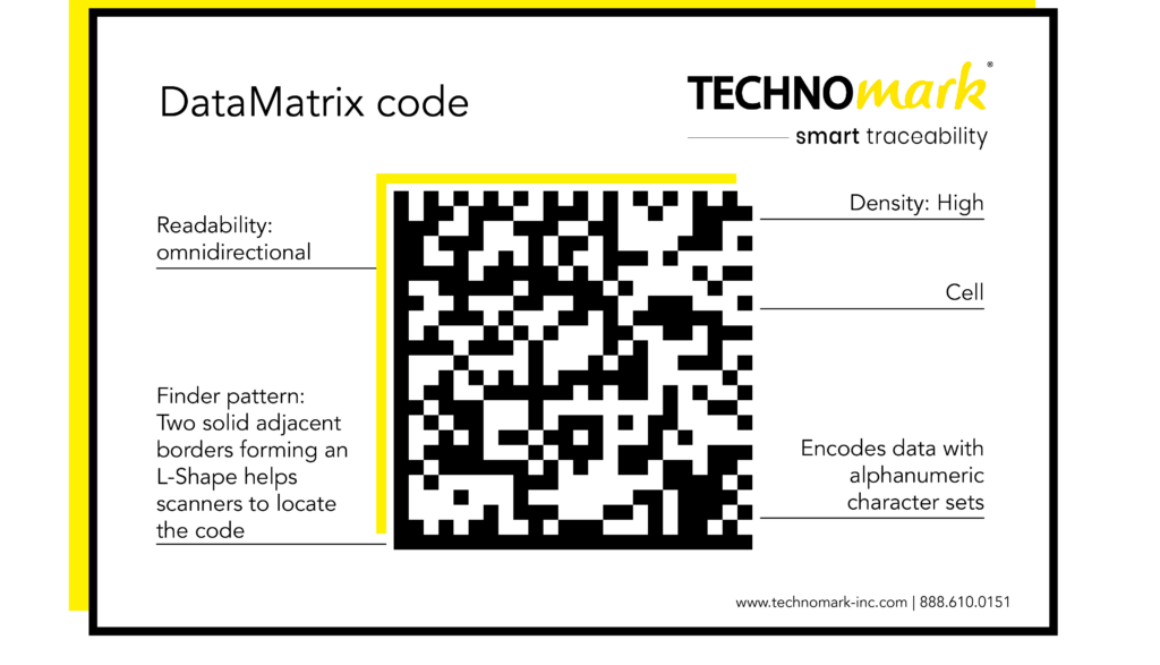
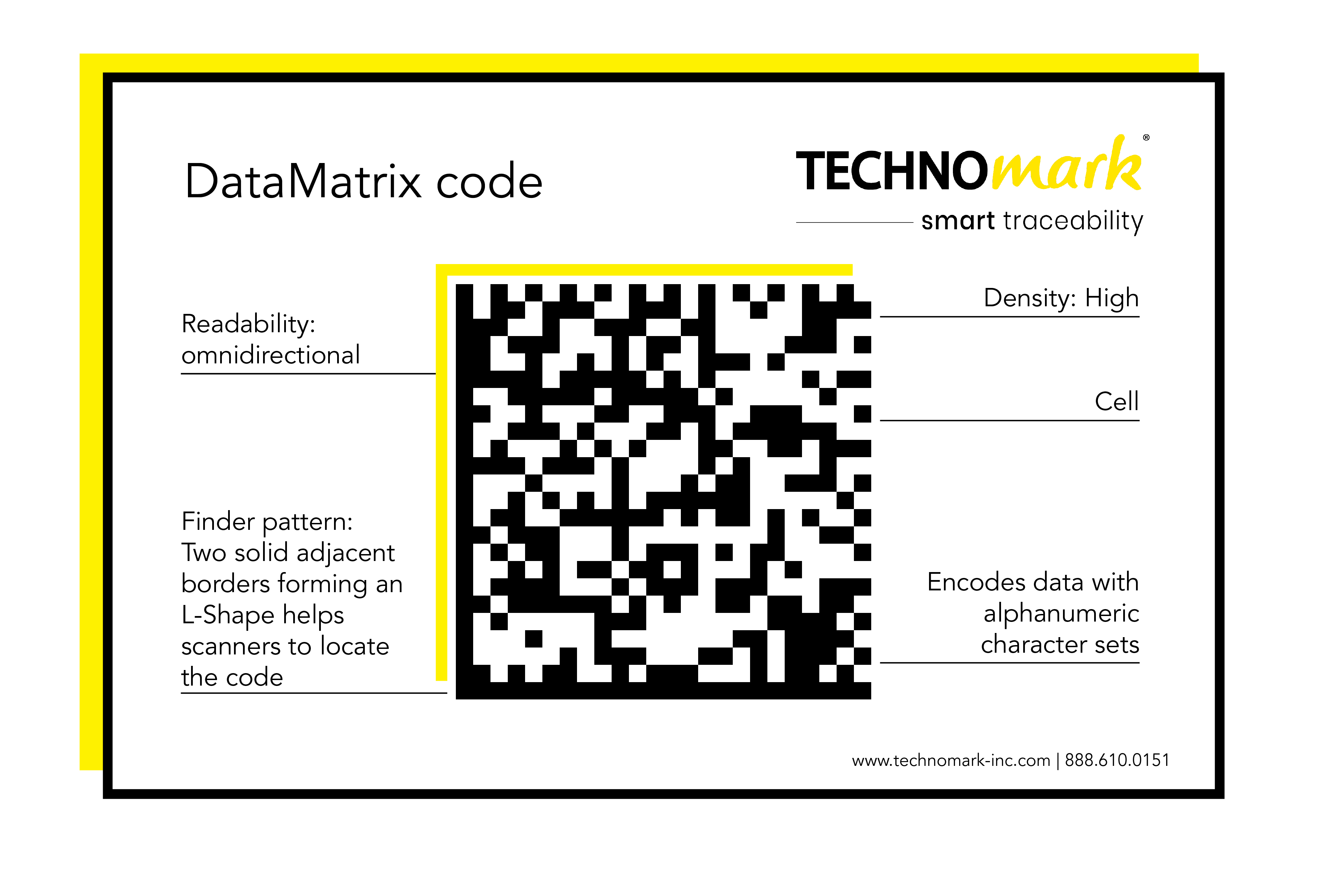
A Data Matrix code is a two-dimensional barcode made up of light and dark modules arranged in a square or rectangular pattern.
Its most recognizable feature is an L-shaped finder pattern along two adjacent sides. The other two sides contain an alternating pattern of light and dark modules. A compatible reader uses these patterns to locate the symbol and determine its size, orientation, and shape.

Data Matrix codes are widely used in manufacturing because they can:
-
Encode data in a small marking area
-
Identify individual parts and components
-
Support serialization and work-in-process tracking
-
Carry lot, batch, date, and production information
-
Be applied through laser, dot peen, printing, or labeling
-
Support automated inspection and traceability systems
Data Matrix ECC 200 uses Reed-Solomon error correction to help reconstruct information when portions of a symbol are difficult to read. The amount of error correction is determined automatically by the selected symbol size and encoded data.
When GS1 identification keys and Application Identifiers are encoded using the required GS1 data structure, the symbol is known as a GS1 DataMatrix. It is important to distinguish GS1 DataMatrix from a standard Data Matrix code because the data formatting and application requirements are different.
What Is a QR Code?
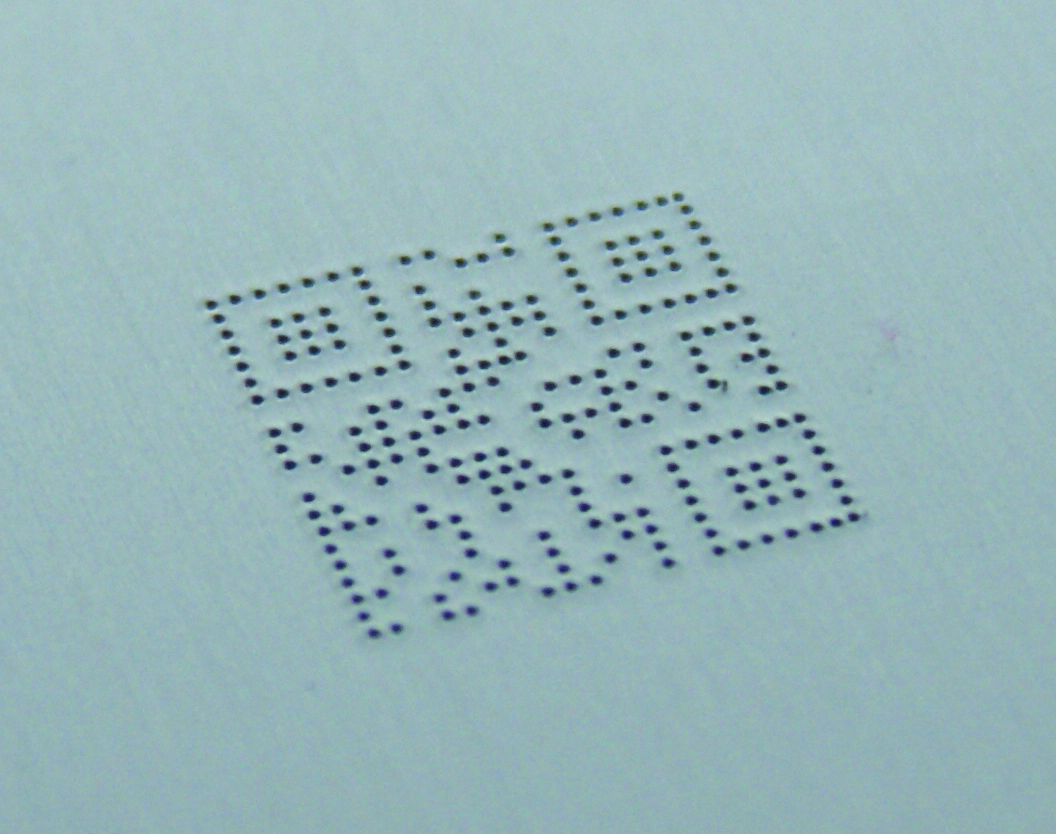
A QR Code is another two-dimensional barcode made up of light and dark modules. It is easily recognized by the three large square finder patterns located in its corners.

QR codes were originally designed for fast scanning, but their widespread recognition by smartphone cameras has made them especially useful for connecting physical products to digital content.
A QR Code may direct someone to:
- A product webpage
- Installation or operating instructions
- Service and maintenance information
- A warranty registration form
- A replacement-parts page
- A safety data sheet
- Marketing or promotional content
QR Code offers four selectable error-correction levels. A higher level provides more redundancy but also requires more space for the same amount of data.
QR Code can be used in industrial environments, and compatible industrial readers may scan both QR and Data Matrix symbols. Its biggest advantage, however, is convenient access through the standard camera application on most smartphones.
Key Differences Between Data Matrix and QR Codes
Code Size and Available Marking Area
Data Matrix is generally more space-efficient for typical industrial data.
This is important when you need to mark small components such as:
- Electronic parts
- Medical instruments
- Aerospace components
- Automotive parts
- Precision-machined products
- Tools and equipment
The final size of either code depends on several variables, including the amount and type of encoded data, required module size, error correction, quiet zone, marking resolution, and applicable industry specifications.
For that reason, it is more accurate to say that Data Matrix is generally more compact, not that it will always be smaller in every possible configuration.
You should determine the minimum required data before choosing a symbol size. Encoding only a unique identifier and linking it to a database is often more practical than placing an entire production record inside the code.
Data Capacity and Content
QR Code has a higher maximum theoretical capacity than Data Matrix. Under ideal conditions, a QR Code can hold up to 7,089 numeric characters or 4,296 alphanumeric characters. Data Matrix can hold up to 3,116 numeric characters or 2,335 alphanumeric characters.
Most industrial applications do not approach either limit.
The more data a manufacturer encodes, the larger or denser the symbol becomes. Increased density can make a mark more difficult to produce and scan consistently, particularly on curved, reflective, rough, or very small components.
A practical industrial code will commonly contain:
- Part number
- Serial number
- Lot or batch number
- Manufacturing date
- Location or supplier identifier
- A unique database record key
Rather than asking which code holds more data, you should ask which data must remain directly associated with the part and which data can be retrieved from a connected system.
Scanning Equipment
Who needs to scan the code is one of the clearest ways to choose between Data Matrix and QR Code.
Data Matrix codes are commonly read with:
- Handheld industrial imagers
- Fixed-mount production readers
- Machine-vision systems
- Specialized mobile scanning applications
QR codes are commonly read with:
- Smartphone cameras
- Tablets
- Handheld industrial imagers
- Fixed-mount readers that support QR Code
Not every smartphone camera processes Data Matrix codes automatically. A dedicated app may be required. By comparison, most modern smartphone camera apps recognize QR codes and open their encoded web addresses without additional software.
If the code will be read by an automated production system, you should evaluate the symbol and reader together. Lighting, working distance, viewing angle, line speed, part orientation, surface reflectivity, and mark contrast can all affect performance.
Durability and Error Correction
Both Data Matrix and QR Code use Reed-Solomon error correction to recover data when a portion of the symbol is damaged, obstructed, or produced imperfectly.
For Data Matrix ECC 200, error correction is automatically determined by the code size and the available symbol capacity.
For QR Code, a user can select one of four approximate error-correction levels:
- Low: 7%
- Medium: 15%
- Quartile: 25%
- High: 30%
These percentages should not be treated as guaranteed damage thresholds. A code’s readability depends on the type and location of damage as well as its contrast, module consistency, quiet zone, marking surface, lighting, and reader.
A code can become unreadable even when only a small area is affected if damage disrupts a finder pattern or another critical feature. A code with greater overall wear may still scan when the damage is distributed differently.
The best approach is to test representative parts under realistic production and lifecycle conditions. Testing should include worn, dirty, coated, corroded, or otherwise degraded samples when those conditions reflect the actual application.
Industrial Standards and Compliance
Data Matrix and QR Code are governed by separate International Organization for Standardization specifications:
- Data Matrix: ISO/IEC 16022:2024
- QR Code: ISO/IEC 18004:2024
Within the GS1 system, several 2D barcode options are available for approved applications. These include GS1 DataMatrix, Data Matrix using GS1 Digital Link URI syntax, and QR Code using GS1 Digital Link URI syntax.
Their use cases are not identical.
GS1 DataMatrix uses GS1 element-string syntax and is widely used to carry identifiers and attributes throughout supply-chain and healthcare processes.
QR Code and Data Matrix can also use GS1 Digital Link URI syntax. This places GS1 identification data in a web-compatible format that can support both product identification and access to online information.
For regulated healthcare trade items, GS1 specifies GS1 DataMatrix as the approved 2D barcode for product identification. QR Code is not approved for that purpose.
You should confirm the requirements that apply to your industry, customer, product category, geographic market, traceability system, and supply-chain partners. For a broader look at regulatory frameworks, identification levels, documentation, and compliance planning, review these best practices for meeting manufacturing traceability requirements.
Selecting a technically capable code does not automatically make your code compliant.

Common Data Matrix Applications
Data Matrix is often the preferred choice when you need durable, unit-level identification.
Common applications include:
- Supply-chain traceability
- Part identification
- Serial number tracking
- Lot and batch control
- Work-in-process tracking
- Quality and inspection records
- Anti-counterfeiting support
- Assembly verification
- Warranty and service records
- Medical device identification
Data Matrix is particularly valuable in complex industries where hundreds or thousands of components must remain associated with accurate manufacturing and lifecycle records.
These industries include:
- Aerospace
- Automotive
- Medical device manufacturing
- Electronics
- Military and defense
- Oil and gas
- Metalworking and fabrication
A Data Matrix code placed directly onto a part can remain with that component through manufacturing, assembly, inspection, field service, and end-of-life documentation.
Common QR Code Applications
QR Code is often the better choice when the primary goal is to connect a person to online information.
Common manufacturing and product applications include:
-
Product information
-
Operating instructions
-
Installation videos
-
Service documentation
-
Spare-parts ordering
-
Product registration
-
Warranty information
-
Safety resources
-
Customer support
-
Promotions and digital experiences
For example, a machine manufacturer may place a QR Code on an equipment enclosure so an operator can quickly open the current manual or maintenance procedure.
That application is different from using a Data Matrix code to track a specific internal component through production.
When to Use Both Codes
The choice does not always have to be Data Matrix or QR Code.
A product may have separate internal and external information requirements. You could use:
-
A Data Matrix code to identify and track the component internally
-
A QR Code to provide customers or technicians with online information
Using separate codes can simplify system design when production personnel and end users have very different scanning equipment and information needs.
Manufacturers considering a single web-connected code may also evaluate GS1 Digital Link. The appropriate approach will depend on industry requirements, scanner readiness, data systems, and the intended user experience.
How to Choose Between Data Matrix and QR Code
Before selecting a code, answer the following questions.
-
If production employees, inspection systems, or supply-chain partners will scan the code with industrial equipment, begin by evaluating Data Matrix.
If customers or field technicians need to scan it using a standard smartphone camera, QR Code will generally provide a more convenient experience.
Choosing a Direct Part Marking Method
Selecting the symbology is only one part of an industrial marking project.
A properly designed Data Matrix code can still fail if the marking process, code placement, surface, contrast, reader, or lighting is not suitable for the application.
Laser marking is a non-contact process that can produce precise, high-resolution codes on many metals, plastics, and other materials.
Depending on the laser and substrate, a mark may be created through processes such as:
-
Etching
-
Ablation
-
Annealing
-
Foaming
-
Color change
Laser systems are often selected for Data Matrix applications that require small modules, high contrast, detailed marks, or integration into an automated production line.

Dot peen marking uses a controlled stylus to create a series of indentations in a component’s surface.
Because it displaces material instead of relying on ink or an attached label, dot peen can produce durable marks on many metal components. It is frequently used in aerospace, automotive, oil and gas, and general metalworking applications.
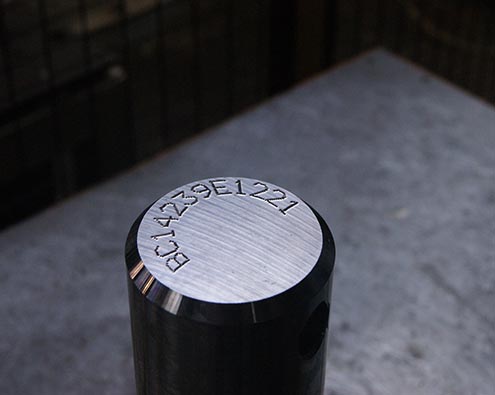
Dot peen systems can create:
- Data Matrix codes
- Serial numbers
- Part numbers
- Dates
- Logos
- Other alphanumeric identifiers
The component’s material, required marking depth, available space, surface finish, and structural requirements should all be considered.
Data Matrix Implementation Checklist
A successful implementation should address the entire marking and scanning process.
Before Implementation
- Confirm customer, industry, and regulatory requirements.
- Select the correct symbology and data structure.
- Define the minimum data that must be encoded.
- Establish the available marking area.
- Evaluate the component material and surface.
- Select the marking and reading technologies together.
- Test representative production parts.
- Define acceptance and verification requirements.
During Implementation
- Protect the required quiet zone around the code.
- Maintain consistent module shape and spacing.
- Produce sufficient contrast for the reader.
- Avoid locations likely to experience damage or distortion.
- Control lighting, reading distance, and part presentation.
- Verify code placement and orientation.
- Prevent duplicate serial numbers.
- Confirm that code data matches the associated production record.
After Implementation
- Monitor first-pass read rates.
- Inspect failed or inconsistent marks.
- Revalidate the process after changing materials, coatings, tooling, or settings.
- Test parts after relevant environmental exposure.
- Document marking and reader configurations.
- Maintain equipment and clean optics as required.
- Continue verifying code quality when mandated by the application.
Find the Right Code and Marking Process for Your Application
For most industrial traceability and direct part marking applications, Data Matrix is the most practical place to begin. For smartphone access and customer-facing digital content, QR Code is generally the better fit.
The code itself is only one part of a reliable system. The material, marking technology, data structure, code size, placement, reader, lighting, software, and verification process must all work together.