Automotive Part Marking 101 | Component Traceability
The number of parts used to make a single car has doubled in the last 10 years. As cars get more complex, it’s harder to track parts through inventory, production, and the car’s entire life.
That’s where automotive part marking comes in. These systems help solve tracking challenges, but they only work if they’re accurate and easy to read. A strong process doesn’t just meet industry rules — it also makes tracking easier, improves safety, and ensures better quality.
Meeting Automotive Industry Standards
The automotive industry is responsible for providing safe and reliable vehicles. With new technologies introduced each year, it’s vital to have a reliable method for tracking parts when issues arise, and a recall is necessary.
In recognition of the importance of recalls and safety, the automotive industry has set high standards for product identification.
While automotive parts identification is required, it also provides several key benefits:
- A product can be marked with serial numbers, part numbers, barcodes, and other information.
- Items can be tracked throughout their entire lifecycle.
- There’s no need for traditional labels, which are prone to fading or falling off.
- Using 2D barcodes, manufacturers can identify very small items and include more data than a linear barcode.
- It improves error prevention for just-in-sequence (JIS) production.
- It reduces the risk of counterfeit parts because the markings are difficult to duplicate.
Part marking is a process used to identify automotive components, improving quality control throughout the production and life cycle of a vehicle. With vehicle components simultaneously increasing in number and decreasing in size, automotive part marking is more important than ever.
Traceability is also a critical factor, as it helps determine where each component came from and how it was made. As such, accuracy and readability are essential for any marking to be useful. With the right part identification methods in place, automotive manufacturers can:
- Meet industry standards
- Ensure the safety and reliability of their products
- Improve future designs
JIS production is a technique where parts are delivered to the assembly line in a manner that perfectly synchronizes with the manufacturing process. Timely and precise delivery allows manufacturers to use resources efficiently while reducing costs. Automotive part marking plays an important role in JIS production by ensuring the process runs smoothly.
The Importance of Traceability
The automotive industry relies heavily on automotive traceability requirements to ensure the quality and safety of its products. Part marking is essential in helping companies trace, manage, and evaluate components over the entire life cycle of a vehicle.
The implementation of direct part marking has:
- Helped with recall management
- Improved part identification on flexible assembly lines
- Improved chain of custody tracking, avoiding product diversion
Recall Management
Traceability provides an easy way to identify faulty parts. With part marking, automotive companies can pinpoint the specific source of a faulty component, enabling them to contain and isolate problems quickly and reduce losses.
Improved Part Identification During Assembly
Automated process control systems require accurate data for maximum efficiency, and part markings help provide that accuracy. Additionally, integrated marking equipment along the production line can read and store this data to optimize the build and speed up production.
Chain of Custody Tracking Improvements
Automotive companies that use part marking are better able to meet customer requirements. Strong chain of custody tracking helps deliver quality parts on time and keep track of what goes where in case problems arise.
Dot Peen vs. Laser Marking Automotive Parts
There are numerous methods of direct part marking that can be used for parts exposed to harsh conditions. Dot peen marking and laser marking are two popular methods used in the automotive industry. Both have advantages and disadvantages to consider.
Dot Peen
Dot peen is a method that involves striking the product material (typically metal) with a marker that displaces a small amount of material to leave a readable mark.
Advantages of dot peen marking include:
- Lower cost
- Durable and permanent mark
- High marking speed
- Minimal mechanical stress
Disadvantages include limited usefulness. This method is effective for metal and plastic but not other materials. The process also exposes parts to mechanical stress, which can weaken the component and potentially increase the occurrence of defects.
Laser Marking
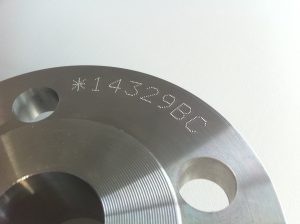
Laser marking is a non-contact method that marks parts using a precise DPM laser beam. It has a higher rate of permanency and accuracy.
Other advantages of laser marking automotive parts include:
- Permanent & accurate mark
- High-quality mark that can be applied to many materials
- Can be done at high speeds; high contrast
- Resistant to heat and liquids
However, there are disadvantages to recognize as well. These include higher costs for a laser marking device and potential issues when materials are exposed to mechanical stress. The energy cost for the laser depends on the type used.
Resource: The Graphix Series provides flexibility in marking depth and offers a solution for a variety of materials. Find out more here.
Integrating New Part-Marking Technology Into Your Process
Part coding and identification help reduce counterfeits and improve the success rates of recalls. This, in turn, has improved vehicle safety and the ability to enhance future designs. With an ever-increasing number of parts used in vehicle manufacturing, now is the time to audit and expand your traceability solutions.
Contact Technomark for Your Part-Marking Needs
Whether you’re a contractor or handle marking in-house, Technomark offers a range of dot peen and laser marking solutions to meet evolving automotive traceability standards. Contact our experts today to ensure your operations are equipped with the latest technology and best practices.

(Editor’s Note: This article was originally published in March 2023 and was recently updated.)